Autofilter
Essentials
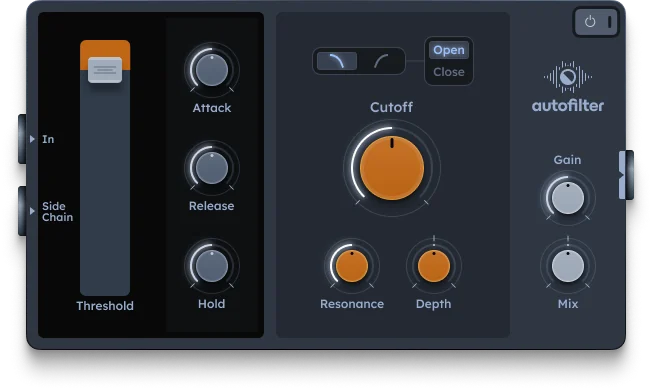
Autofilter is a dynamic filter driven by an envelope follower or sidechain input. It opens/closes a low-pass or high-pass filter based on input level, creating rhythmic movement and ducking effects automatically. Perfect for adding movement to pads, creating sidechain pumping, or rhythmic filtering.
Envelope follower or sidechain input
Low-pass and high-pass filter modes
Automatic rhythmic movement
Sidechain triggering for creative effects
Great for pads, bass, and rhythmic filtering
Envelope
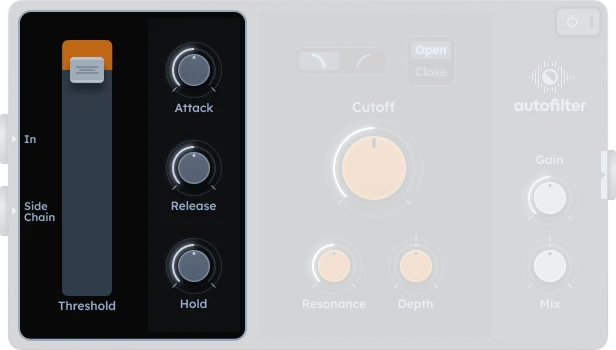
Threshold |
Input level at which the envelope follower starts responding (0-100%, equivalent to -∞ to 0 dB) |
|---|---|
Attack |
How quickly the follower responds to rising levels (1-2000 ms) |
Sustain |
Holds the envelope to sustain modulation (1-2000 ms) |
Release |
How quickly it returns after the signal falls (1-2000 ms) |
Sidechain |
Optional external input for sidechain triggering. If connected, uses sidechain signal to determine filter movement instead of main input. |
Filter
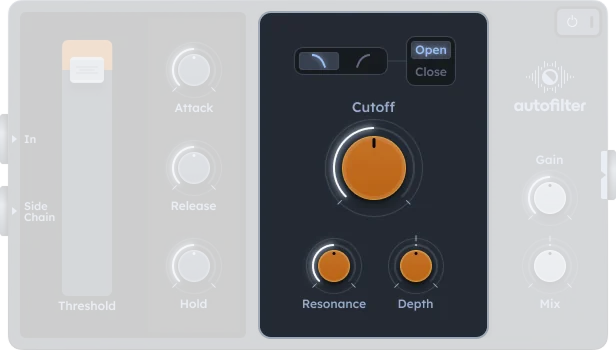
Mode |
Filter mode:
|
|---|---|
Cutoff |
Frequency where filtering begins (18-10000 Hz). In inverted mode: when filter is triggered. In normal mode: when filter is not triggered. |
Resonance (Q) |
Emphasis around the cutoff frequency (0.01 to √2). Higher values create more pronounced resonance peaks. |
Depth |
Envelope modulation amount for cutoff (-100% to +100%). In inverted mode: how far away the cutoff is when not triggered. In normal mode: how far away the cutoff is when triggered. |
Output
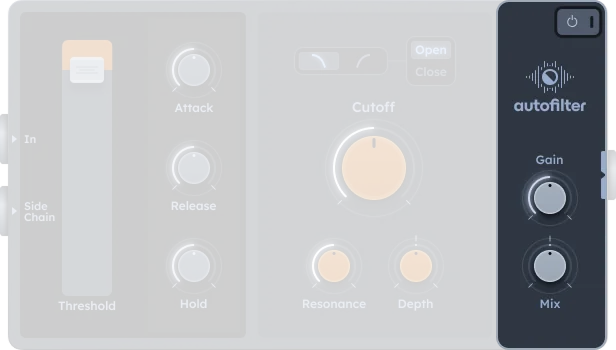
Gain |
Output level after filtering (-inf to +9 dB equivalent) |
|---|---|
Mix |
Blend between dry and filtered signals (0-100%). 0 = 100% dry, 100% = 100% wet. |
On/Off |
Activates or bypasses the effect |
Practical Tips
Practical Tips
Rhythmic movement: Add rhythmic filter motion to basses, leads, or drums.
Transient emphasis: Emphasize transients or create swell effects.
Dynamic carving: Carve space dynamically in a busy mix.
Bass/synth motion: Add subtle or dramatic movement.
Sidechain pump: Feed drums to sidechain for rhythmic pumping.
Close mode: Use for ducking or reverse-motion effects.
Resonance + depth: Combine for sharper, expressive peaks.