Pulverisateur
Essentials
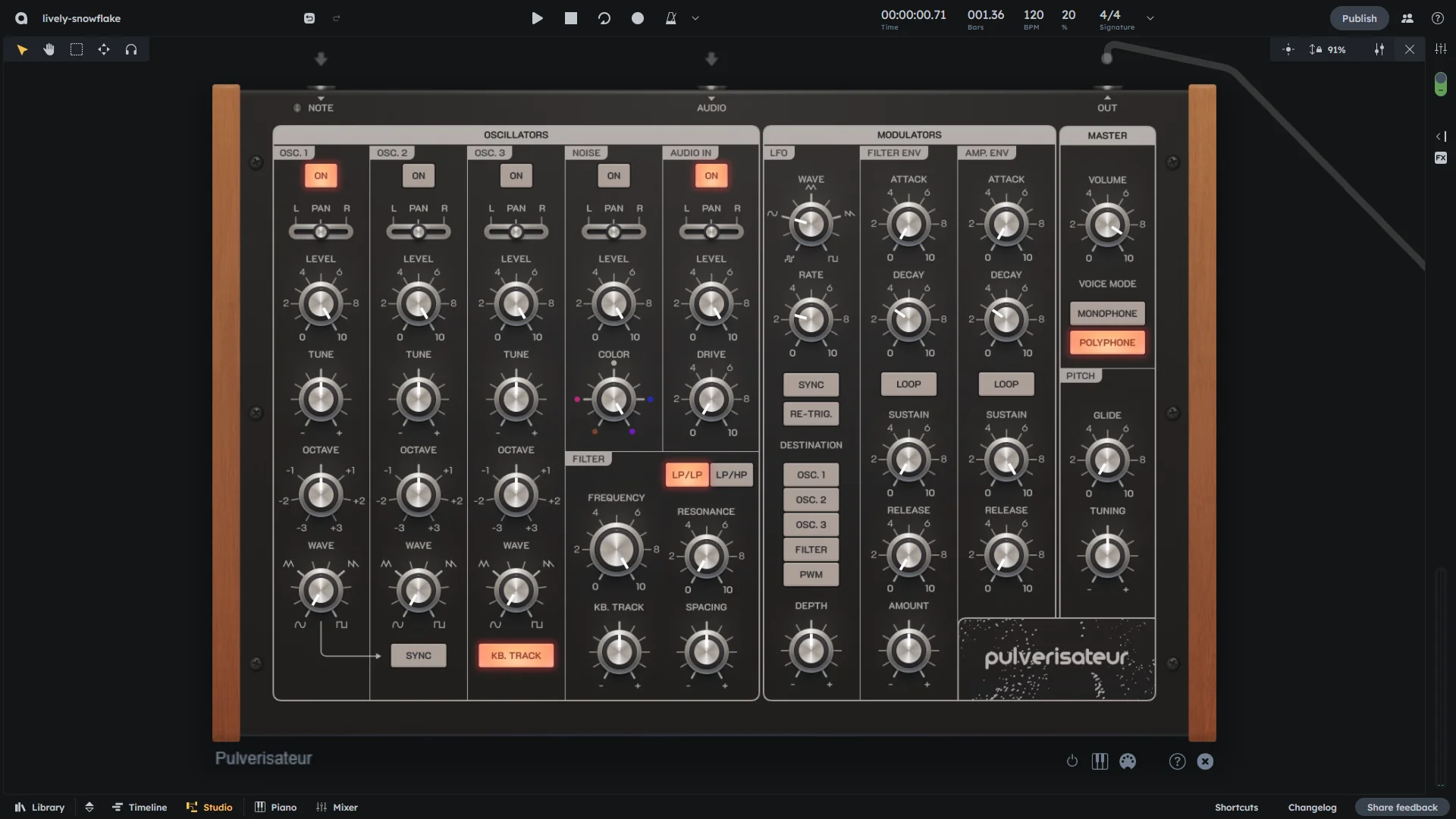
Pulverisateur is a versatile virtual-analog synthesizer with three oscillators, noise and audio-in, dual filters, envelopes, LFO, and a full master section. Perfect for classic subtractive synthesis, complex modulated sounds, basslines, leads, and pads.
Three oscillators with noise and audio input
Dual filters (LP/LP or LP/HP modes)
Envelopes and LFO with tempo sync
Mono and polyphonic play modes
Micro-tuning support
Full master section with gain control
Oscillators
The sound sources and inputs.
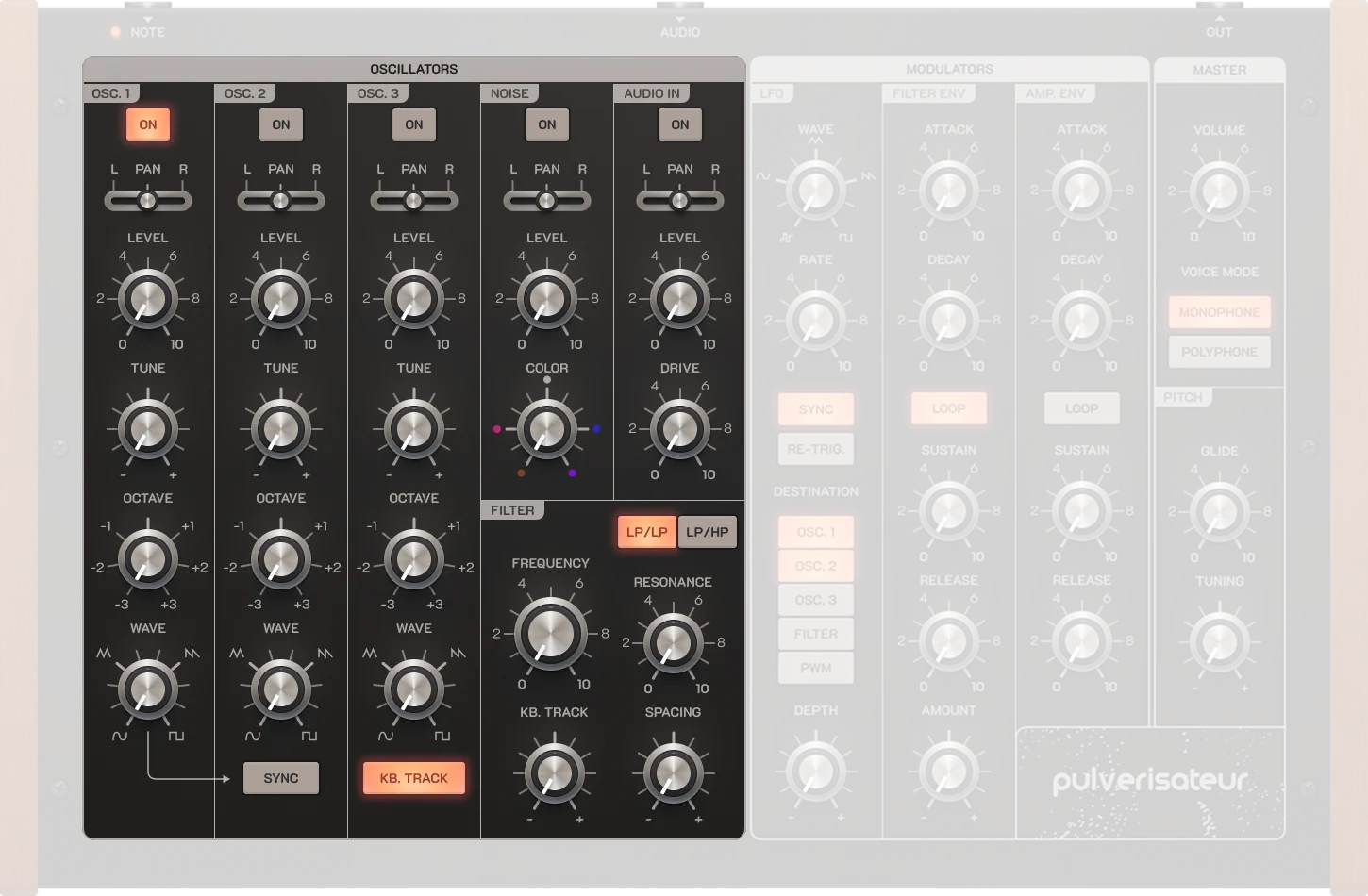
OSC1–OSC3
The three primary oscillators form the core sound source of the Pulverisateur.
On/Off |
Activates the respective oscillator (). When disabled, the oscillator produces no sound |
|---|---|
Waveform |
Morph or select Sine, Triangle, Sawtooth, Square (PWM-capable) |
Octave |
Shifts pitch in octave steps |
Tuning |
Fine tune for subtle detuning/chorus |
Panning |
Stereo placement (-100 to 100%). 0% = centered, positive = right, negative = left |
Level |
Oscillator volume in the mix (0-100%). Equivalent to a dB range of [-∞, 0] |
(OSC2) Sync |
Locks OSC2 to OSC1 cycle for metallic overtones |
(OSC3) Key Track |
Disable for fixed-pitch drones or modulation sources |
Noise
The noise generator adds texture and character to the sound, or can be used as a standalone sound source.
On/Off |
Activates the noise generator (). When disabled, the noise produces no sound |
|---|---|
Noise Type |
From white to pink-like spectra (as implemented); adds air or grit |
Panning |
Stereo placement (-100 to 100%). 0% = centered, positive = right, negative = left |
Level |
Noise volume (0-100%). Equivalent to a dB range of [-∞, 0] |
Audio-In
The audio input allows external signals to be processed through the Pulverisateur’s filter and effects.
On/Off |
Enables the external audio input path (). When disabled, the audio input produces no sound |
|---|---|
Panning |
Stereo placement of input (-100 to 100%). 0% = centered, positive = right, negative = left |
Level |
Input gain (0-100%). Equivalent to a dB range of [-∞, 0] |
Drive |
Adds saturation/distortion to the input signal before further processing (0-100%). Similar to the waveshaper device |
Filter
The filter alters the harmonic content of all sound sources, with two distinct modes for shaping frequency response.
Filter Mode |
Filter configuration:
|
|---|---|
Cutoff |
Frequency threshold that determines which frequencies pass through (18-15500 Hz) |
Resonance |
Emphasis at the cutoff frequency for peak/character (0-100%) |
Keyboard Track |
Modulates cutoff with note pitch on the note track (-100 to 100%). Positive values increase cutoff with higher notes |
Spacing |
Adjusts the difference between the two filters’ cutoffs (-100 to 100%). Only has an effect in LP/HP mode, ignored in LP/LP mode |
Modulators
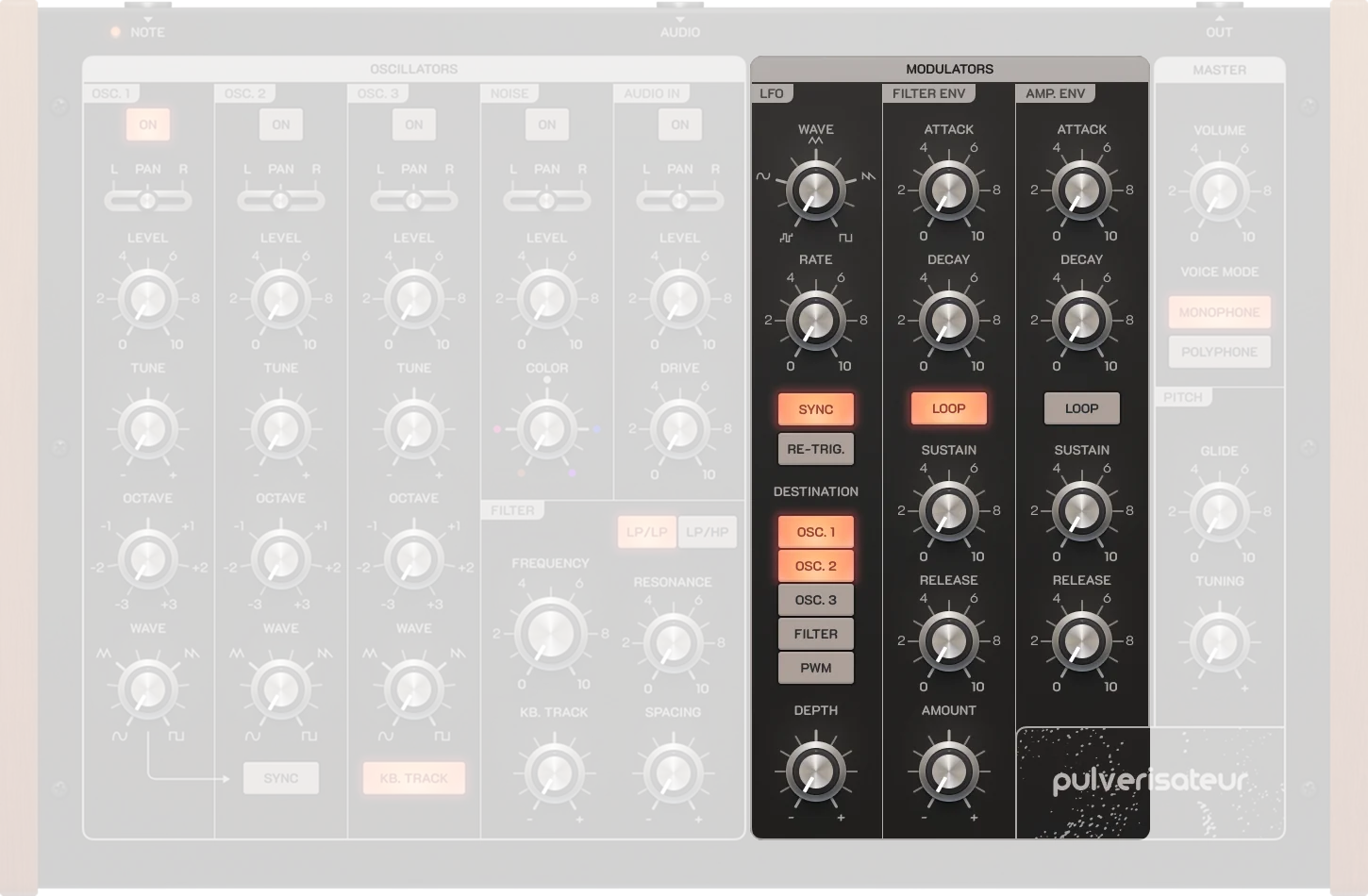
LFO (Low Frequency Oscillator)
The LFO provides rhythmic modulation for creating movement and texture in the sound.
Waveform |
Selectable waveforms including Sine, Square, Saw, Triangle |
|---|---|
Rate |
Modulation speed. When not synced: 1-10000 ms . When synced to tempo: quantized to musical note durations (e.g., 1/1, 1/2, 1/4 bars) |
Sync |
Enable tempo synchronization. When enabled, rate is quantized to musical note values; when disabled, rate is in milliseconds |
Trigger |
Restart the LFO on each note-on () |
Destination |
The target parameter to be modulated (e.g., Pitch, Filter Cutoff, PWM) |
Depth |
Modulation amount (0-100%). Controls how strongly the LFO affects the target parameter |
Filter Envelope (ENV-F)
The filter envelope modulates the cutoff frequency over time, shaping the tonal character of each note.
Attack |
Time to rise to maximum filter modulation (1-5000 ms) |
|---|---|
Decay |
Time to fall from attack to sustain level (1-5000 ms) |
Sustain |
Steady-state filter modulation level (0-100%) |
Release |
Time to return to zero after note-off (1-20000 ms) |
Amount |
How strongly the envelope affects filter cutoff (0-100%) |
Loop |
Repeats the decay stage for cyclic modulation (). When enabled, the decay phase repeats indefinitely, going forward and backward |
Amp Envelope (ENV-A)
The amplitude envelope controls the volume contour of each note over time.
Attack |
Time to reach maximum amplitude (1-5000 ms) |
|---|---|
Decay |
Time to fall from attack to sustain level (1-5000 ms) |
Sustain |
Steady-state amplitude level (0-100%) |
Release |
Time to silence after note-off (1-20000 ms) |
Loop |
Repeats the decay stage for tremolo-like effects (). When enabled, the decay phase repeats indefinitely, going forward and backward |
Master
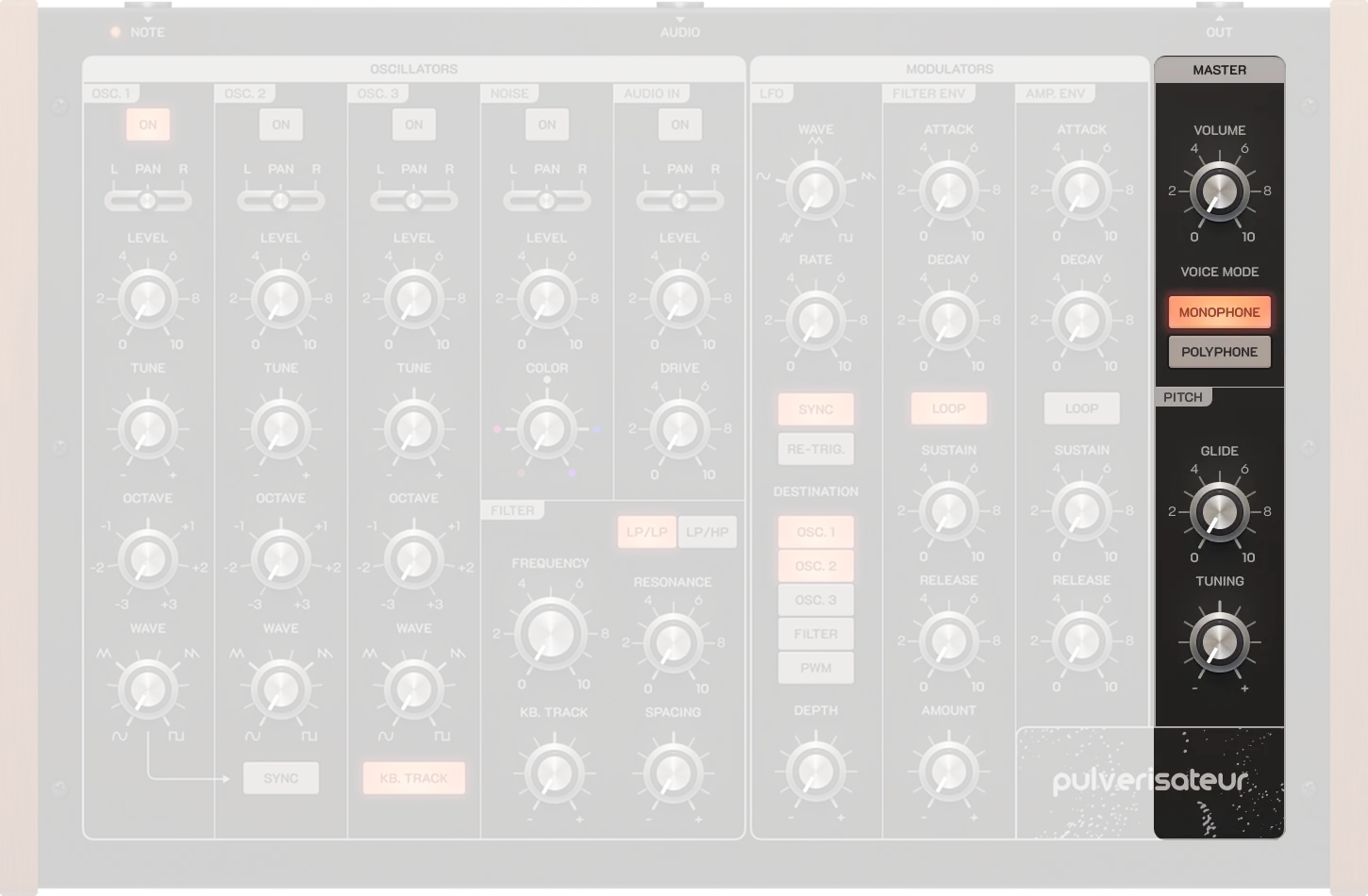
Output
Master Volume |
Final output level of the device (0-100%). Equivalent to a dB range of [-∞, 0] |
|---|---|
Active |
Enable/disable the device (). When disabled, no audio is produced, including audio passed through the audio input |
Pitch
Global Tune |
Overall pitch tuning for all oscillators (-12 to +12 semitones) |
|---|---|
Glide |
Portamento time between consecutive notes (0-10000 ms). The amount of time pitch change for a new note takes |
Play Mode |
Play mode:
|
Micro-tuning |
Optional reference to a micro-tuning resource for alternative tuning systems |
Practical Tips
Practical Tips
Use detuning and panning for stereo width.
Animate filters with LFO or envelope for expressiveness.
Run external audio through filters for creative processing.
PWM with LFO adds analog character.
Hold Shift + Cmd (Mac) / Ctrl (Win) for ultra-fine tuning.
Sequence via a Note Track or Tonematrix; all parameters are automatable.